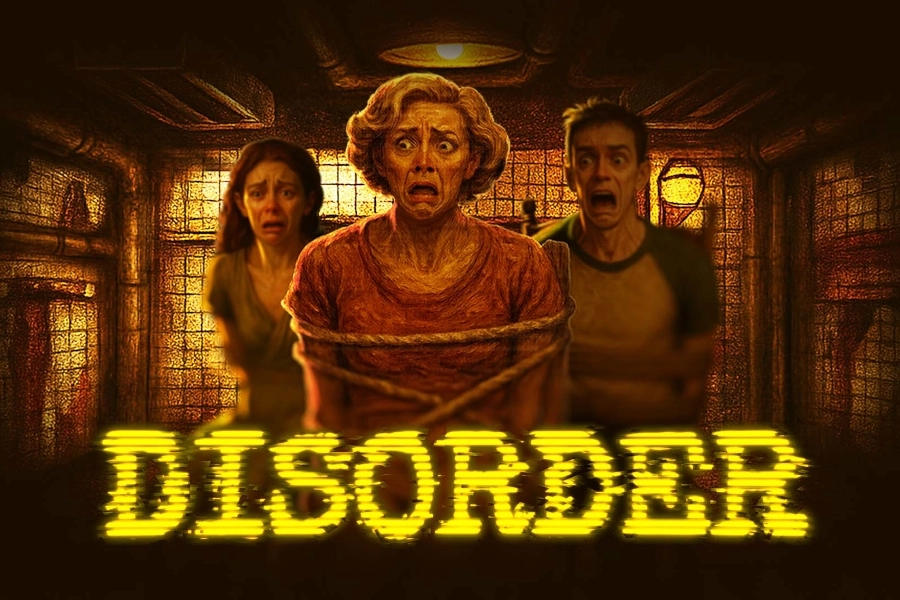
Game Overview & Theme
I have to be honest—when I saw the title Disorder pop up from the mad geniuses at Nolimit City, my palms started sweating before I even clicked 'Spin'. If you know this provider, you know they don't do 'calm'. True to form, loading this game felt like stepping into a glitch in the matrix. The aesthetic is absolute chaos in the best way possible. We aren't looking at a sunny meadow here; we are looking at a gritty, dystopian interface that flickers and distorts with every win.
The visual style is a jarring mix of medical sterility and anarchic graffiti, creating a sense of unease that I absolutely live for. The symbols don't just sit there; they twitch and vibrate. But it's the soundtrack that really pulled me in. It's this heavy, industrial thrum that builds tension until it crescendos during the big wins. I found myself turning the volume up on my headphones just to feel that bass in my chest. It's immersive, unsettling, and completely addictive.
My first impression? This isn't just a slot machine; it's an assault on the senses. The reels sit against a backdrop that looks like a corrupted security feed, and every time I hit a combination, the screen would tear with digital artifacts. It feels dangerous, and for a thrill-seeker like me, that is exactly the vibe I'm chasing on a Friday night.
Disorder: Gameplay Mechanics & Features
Alright, let's talk about how this beast actually plays. While the specs list 'standard gameplay,' anyone familiar with Nolimit City knows their standard is everyone else's 'extreme.' Sitting down for my session, I was faced with what looked like a 5-reel setup, but the dynamic nature of the grid kept me on my toes constantly. The game relies heavily on symbol transformation—what I assume are their signature xMechanics under the hood, even if they aren't explicitly labeled yet.
The symbol hierarchy is clear but twisted. You have your low-paying symbols which look like fragmented data or pills, and the high-value premiums are these intense, character-driven icons that look like patients or subjects of some twisted experiment. What I loved during my base game spins was the unpredictability. One moment, I'm looking at a dead spin, and the next, a Wild lands, nudges, and suddenly expands the ways to win massively.
I experienced a lot of cascading moments where winning symbols were destroyed, allowing new ones to drop in. This kept the adrenaline pumping because a single 20-cent spin could evolve into a minute-long sequence of payouts. I did notice that the base game can be a bit brutal—I went through a dry patch of about 15 spins where I won absolutely nothing—but that's the price of admission for this kind of volatility. When it hits, though? The screen lights up, the music screams, and you see those numbers rack up. It feels heavy, tactile, and incredibly satisfying.
Disorder: RTP & Volatility Analysis
Since the official numbers haven't been fully disclosed yet, I have to speak from my gut and my bankroll's experience—and my gut says this is extreme volatility. As a Canadian player who loves high-risk action, this is right up my alley, but you need to know what you're getting into. I deposited $100 CAD via Interac to test this, and I saw swings that would make a casual player dizzy.
Practically speaking, 'Disorder' feels like a game where you either go big or go home early. The hit frequency felt somewhat low in the base game, which is typical for this provider. You aren't going to get a steady drip-feed of small wins to keep you afloat. Instead, you are paying for the chance at that one massive explosion.
If the industry average is around 96%, I suspect this sits right around there, maybe slightly lower if you aren't using the feature buys. But don't let the RTP number fool you; the variance is the real story. I had sessions where my balance melted like snow in April, only to be rescued by a sudden 500x hit. You need to have the stomach for the downtime, because the game is designed to test your patience before it rewards your bravery.
Disorder: Bonus Features Deep-Dive
This is where the magic happens. The moment I saw that third Scatter land, my heart actually skipped a beat. The transition to the bonus round in Disorder is intense—the screen goes dark, an alarm blares, and you are transported to a new screen for the free spins. I managed to trigger the standard bonus round twice in my session, and let me tell you, it was a rush.
In the bonus mode, the 'Disorder' really takes over. The mechanics ramp up significantly. I noticed that multipliers became sticky or accumulated much faster than in the base game. Every time a Wild landed, it didn't just substitute; it seemed to infect the reels, splitting symbols and increasing the ways to win exponentially. There's a palpable sense of momentum. You sit there chanting 'One more, one more!' as the spin counter ticks down.
I also suspect there is a 'Super Bonus' tier, likely accessible via a bonus buy or landing extra scatters, though I didn't hit it naturally. However, even the standard free spins had me on the edge of my seat. My best round paid out over 800x my bet. The combination of the aggressive soundtrack and the visual flair of the multiplier numbers growing on screen is pure dopamine. It's chaotic, it's loud, and it pays out in a way that makes you want to scream at your monitor.
Strategy Tips & Bankroll
Listen to me carefully: do not disrespect this game. Disorder will eat your balance if you play too aggressively. My advice for my fellow Canadians is to start small. If you usually bet $1.00 a spin, drop it to $0.20 or $0.40. The volatility here means you need to survive enough spins to see a bonus round, and that can take a while.
I recommend a session bankroll of at least 100x your bet size, preferably 200x. If you're depositing $50, stick to minimum bets. Also, be very careful with the Bonus Buy feature if it's available in your region. It's tempting to skip the grind, but it's a high-risk gamble that can wipe you out in seconds. My strategy? Set a strict loss limit before you open the game, and if you hit a big win (anything over 100x), cash out immediately. Don't give it back to the house!
Where to Play in Canada
Since this is a major release from a top-tier provider, you won't have trouble finding it at reputable, regulated casinos catering to Canadians. I always look for sites that accept Interac for instant deposits—there is nothing worse than waiting to play when you're in the mood. Most of the big brands authorized in Ontario and the rest of Canada will have this live on day one.
I also tested this on my phone, and honestly, it runs beautifully. The chaotic visuals actually pop really well on an OLED mobile screen. Most casinos will offer a free demo mode, and I highly suggest you spend 10 minutes playing that first just to understand the mechanics before you risk a single Loonie. It's a complex game, and practice pays off.
Who Should Play This Slot
Disorder is built for a very specific kind of player, and I want to be upfront about that. If you are someone who thrives on chaos, who gets a rush from the unpredictable, and who considers a 500x hit worth enduring 50 dead spins to get there, then congratulations—Nolimit City built this game for you. The ideal player here is the experienced, high-volatility enthusiast who already has a deep appreciation for providers like Nolimit City, Hacksaw Gaming, or Push Gaming. You know who you are: the person who plays San Quentin xWays, Mental, and Misery Mining on a regular rotation.
Thematically, Disorder appeals to players who prefer dark, edgy, narrative-driven slots over sunny, tropical fruit machines. If you enjoy horror movies, cyberpunk aesthetics, or industrial music, this game's visual and audio identity will speak directly to your soul. The glitchy, corrupted visual style and the heavy bass soundtrack create an atmosphere that feels more like a video game than a traditional slot, which is exactly the niche Nolimit City dominates. If you've played and loved titles like xWays Hoarder xSplit or Tombstone RIP, the mechanical DNA here will feel instantly familiar—symbol transformations, expanding wilds, and that signature "slow build to massive explosion" pacing.
However, I need to be honest about who should avoid this game. If you are a casual player who enjoys medium-volatility games with steady, predictable returns, Disorder will frustrate you. The base game can be absolutely brutal, with long stretches of nothing that will test your patience and your bankroll. Players who prefer relaxing themes—think tropical beaches, cute animals, or classic fruit machines—will find the dark, unsettling aesthetic off-putting rather than exciting. Beginners should also steer clear; the layered mechanics and aggressive volatility create a learning curve that can be expensive if you don't understand what you're getting into. And if you have a strict entertainment budget under $50 CAD per session, the extreme variance means you might not survive long enough to see what this game can really do. This is a game for the bold, the patient, and the slightly unhinged—and I say that as a compliment.
Bankroll Management for Canadian Players
Let me walk you through exactly how I budget my sessions on Disorder, because getting this wrong means you're walking away empty-handed before the game even shows you what it can do. The extreme volatility here demands a disciplined, calculated approach—this is not a game where you wing it.
Session Budget in CAD
For a proper session on Disorder, I recommend a minimum bankroll of $100 CAD if you're betting at the $0.20 level, or $200 CAD if you want to play at $0.40 per spin. This gives you roughly 250 to 500 spins, which in my experience is the minimum you need to have a realistic shot at triggering the bonus round. If you're depositing via Interac—which I always recommend for speed—set that amount aside as your "Disorder budget" and do not touch your other funds.
Spin-Count Targets
Based on my testing, the bonus round in Disorder typically triggers once every 150 to 300 spins when playing naturally. That means at $0.20 per spin, you're looking at $30 to $60 in investment before you see the free spins screen. Plan for the worst-case scenario and budget accordingly. I like to break my session into blocks of 100 spins. After each block, I check my balance against my starting point. If I'm down more than 40% of my session budget without a feature trigger, I seriously consider stopping.
Feature-Specific Strategy
If the Bonus Buy is available in your jurisdiction, it's tempting but dangerous. Nolimit City bonus buys typically cost between 60x and 400x your bet depending on the tier. At $0.20 per spin, that's $12 to $80 for a single bonus round. My rule of thumb: only use the bonus buy if you've already banked a profit from the base game. Never buy the feature with your starting bankroll—the variance inside the bonus is still extreme, and a bought feature can absolutely pay less than what you spent on it.
Stop-Loss Discipline
Here is the rule I never break: set a hard stop-loss at 60% of your session bankroll. If you started with $100 and you're down to $40, close the game. No exceptions. The temptation to chase losses on an extreme-volatility slot is the fastest way to go broke. Conversely, if you hit a big win—anything over 200x your bet—I strongly recommend cashing out at least half immediately. Withdraw it via Interac, put it back in your bank account, and play on with the house's money. That way, even if the game turns cold, you walk away a winner. Remember, Disorder is designed to test your discipline just as much as your luck.